
Publishing a book today looks nothing like it did even five years ago. Self-published authors now put out millions of new titles every year, audiobooks are one of the fastest-growing formats in the entire industry, and platforms keep shifting their rules around AI-assisted writing. If you're sitting on a finished manuscript (or one that's almost finished) and wondering what actually needs to happen between “I wrote a book” and “people are buying my book,” this guide walks through every stage of the process.
This is also the exact roadmap Evercrest Publishing uses with its own authors. Evercrest is a full-service publishing and marketing companythat handles everything from line editing to global distribution, so wherever a step below feels overwhelming, know that it's a service authors regularly hand off entirely.
Step 1
Finish the Manuscript and Get It Reader-Ready
Before anything else touches your book, the manuscript itself needs to be complete and internally consistent. That means:
- A finished first draft, start to finish, with no placeholder scenes or “figure this out later” notes
- A self-edit pass where you check for plot holes, timeline errors, and characters whose names or details change halfway through
- A structural gut check: does the book deliver on what the opening promises? Does the ending earn its payoff?
Plenty of authors get stuck here because it's hard to see your own work clearly after months of staring at it. A second set of eyes at this stage, even just a trusted reader, tends to save weeks of rework later.
Step 2
Professional Editing
Editing is not one step. It's usually three or four distinct passes, each catching different things:
- Developmental editing looks at the big picture: pacing, structure, character arcs, whether the middle sags, whether the argument in a nonfiction book actually holds together chapter to chapter.
- Line editing works sentence by sentence, sharpening voice, tightening prose, and cutting anything that slows the reader down.
- Copyediting catches grammar, consistency, and factual errors, house-style issues, and continuity slips (a character's eyes that change color, a timeline that doesn't add up).
- Proofreading is the final pass after formatting, catching typos and layout errors right before the file goes live.
Step 3
Cover Design
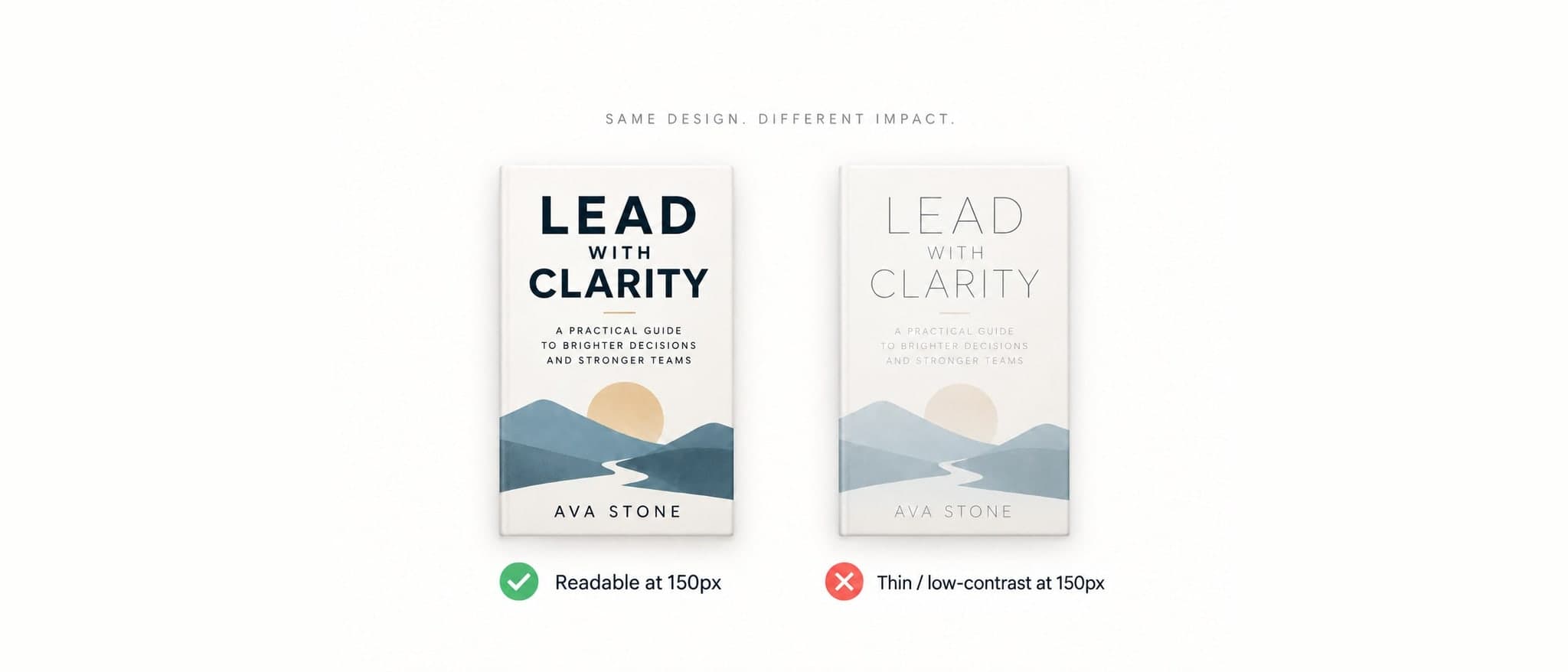
Your cover is doing more selling than almost anything else about your book. On Amazon, it's a thumbnail competing against thousands of other thumbnails, and it has a fraction of a second to signal genre, tone, and quality before a reader scrolls past.
A strong cover brief covers:
- Genre conventions — readers use cover style to sort books before they even read the blurb, and a cover that doesn't “look like” its genre gets skipped
- Typography that's legible at thumbnail size, not just at full resolution
- A design that works in both ebook and print formats, including a full wraparound spine and back cover for paperback and hardcover editions
This is one area where DIY tools tend to show. A cover built by someone who designs book covers for a living, with an understanding of what your specific genre's readers respond to, reliably outperforms a template.
Step 4
Formatting for Print, Ebook, and Large Print
Formatting is the unglamorous step that quietly breaks a lot of self-published books. Every platform has its own technical requirements:
- Ebook (EPUB/MOBI): proper heading structure, a working table of contents, reflowable text that displays correctly across phone screens, tablets, and e-readers
- Print (paperback and hardcover): exact trim size, bleed, margins that account for the gutter (the inner margin that disappears into the spine), and a cover file sized to the precise page count, since a 200-page book and a 400-page book need different spine widths
- Large print editions: increasingly requested by libraries and older readers, with their own type-size and layout standards
Getting any of these wrong causes real problems: text that's cut off mid-page in print, a table of contents that doesn't link anywhere in the ebook, or a cover upload that gets rejected because the spine width is off by a few millimeters.
Step 5
ISBNs, Copyright, and the Legal Basics
An ISBN (International Standard Book Number) identifies your book to retailers, libraries, and distributors. A few things worth knowing:
- Each format of your book — ebook, paperback, hardcover, audiobook — needs its own ISBN
- Amazon KDP will assign you a free ISBN, but that ISBN lists Amazon as the publisher of record, not you. If you want your own publishing imprint listed, you'll need to buy your own ISBNs (in the US, through Bowker; other countries have their own national ISBN agencies)
- Copyright exists automatically the moment you write something, but formally registering it (in the US, through the Copyright Office) gives you stronger legal standing if you ever need to enforce it
None of this is complicated once you know the order of operations, but it trips up a lot of first-time authors who buy ISBNs after they've already uploaded a book, or who don't realize their ebook and paperback need separate numbers.
Step 6
Choose Your Publishing Path
There are three broad routes, and 2026's numbers tell you where most authors are actually landing: self-published titles now dramatically outnumber traditionally published ones, and a majority of newer authors say they'd choose an independent path even if a traditional deal were on the table.
- Traditional publishing: You pursue a literary agent, who pitches publishing houses. If accepted, the publisher covers editing, design, and distribution costs in exchange for the bulk of the rights and royalties. Timelines are long, often one to two years from acceptance to shelf, and control over cover, title, and edits is limited.
- Self-publishing: You retain full rights and the large majority of royalties, control every creative decision, and can move from finished manuscript to live book in weeks rather than years. The tradeoff is that every step in this guide — editing, design, formatting, distribution, marketing — is on you to arrange.
- Hybrid/assisted publishing: A publishing company provides the professional production and distribution support of a traditional publisher, while you retain your rights and a much larger royalty share, and pay for services rather than signing them away.
Step 7
Understand AI Content Disclosure Rules
This one is genuinely new for 2026 and catches a lot of authors off guard. Amazon KDP now requires publishers to disclose, during the upload process, whether a book contains AI-generated text, cover art, or translations. The distinction that matters:
- AI-generated content (an AI tool created the actual text, image, or translation) must be disclosed, even if you edited it heavily afterward
- AI-assisted work (using AI to brainstorm, check grammar, refine your own writing, or polish an image you created) does not need to be disclosed
The disclosure itself is internal to Amazon, it isn't shown to readers on your book's page, and Amazon has stated it doesn't affect royalties or ranking. But failing to disclose accurately, or misclassifying AI-generated content as merely “assisted,” can get a book blocked or a whole account flagged for review.
Step 8
Distribution: Getting Your Book Everywhere Readers Are
Once your files are ready, distribution decides where your book can actually be bought. The big decision points:
- Amazon KDP: the largest single retailer for self-published books by a wide margin, with print-on-demand paperback and hardcover options alongside Kindle ebooks
- IngramSpark: the standard for reaching bookstores, libraries, and international retailers beyond Amazon, including print-on-demand distribution that lets independent bookstores order single copies
- Going wide vs. Amazon exclusivity: KDP Select requires ebook exclusivity to Amazon in exchange for Kindle Unlimited access and some promotional tools; “going wide” means distributing everywhere (Apple Books, Kobo, Barnes & Noble, Google Play, and more) at once. Neither is universally correct — it depends on your genre and where your specific readers actually shop.
Step 9
Produce and Distribute an Audiobook
Audiobooks are one of the strongest growth areas in publishing right now, and the platform landscape has shifted meaningfully in the last couple of years:
- ACX (Amazon's audiobook platform) remains the only direct path to Audible, and is available to rights holders in the US, UK, Canada, and Ireland. It offers an exclusive tier (Audible, Amazon, and Apple Books only, locked in for seven years) and a non-exclusive tier with a lower royalty rate but no lock-in.
- Voices by INaudio (the platform formerly known as Findaway Voices, now independent again after its founding team reacquired it from Spotify) is the main wide-distribution option, pushing a finished audiobook out to 40-plus retailers and library platforms, including Spotify, Apple Books, Kobo, Scribd, and OverDrive, without requiring exclusivity.
- Spotify for Authors is Spotify's own direct self-publishing portal, a newer option separate from going through an aggregator.
A common strategy is publishing non-exclusively through ACX to reach Audible and Amazon, while simultaneously distributing wide through an aggregator to pick up everywhere else. Production itself — hiring a narrator, directing the recording, and mastering the files to each platform's technical spec — is its own specialized process.
Step 10
Build an Author Website
A website is the one piece of your online presence you actually own, unlike a social media following, which lives on a platform that can change its algorithm (or its terms of service) overnight. A solid author site should have:
- A clear landing page introducing you and your books
- A mailing list signup, ideally with a small incentive (a free short story, a bonus chapter, a resource tied to your nonfiction topic)
- Direct links to buy each book across the platforms it's available on
- A blog or updates page, useful for both readers and search visibility
Direct reader relationships, built through a website and an email list rather than rented entirely from a platform, are one of the clearest trends among successful indie authors right now. It's the difference between reaching your audience directly and hoping an algorithm decides to show them your post.
Step 11
Plan Your Marketing and Launch
Marketing needs to start well before your launch date, not after. A reasonable timeline:
- 8-plus weeks out: build an ARC (advance reader copy) list, reach out to book bloggers and reviewers in your genre, start teasing the book on social media
- Launch week: coordinate reviews to post as close to launch day as possible (early reviews matter a lot for a book's algorithmic visibility), run any planned ads, send the announcement to your mailing list
- Post-launch: keep a steady drumbeat of content rather than going quiet the week after launch, since long-term sales usually matter more than opening week
For most authors, discoverability and marketing — not writing or editing — are the hardest parts of the whole process. That's consistent with the pattern across the industry: authors who invest in it early tend to have a much better shot at their book finding real traction.
Step 12
Build Long-Term Credibility and Keep Growing
Publishing a book is a start, not a finish line. A few things that pay off long after launch day:
- Reviews: a steady stream of honest reviews, on Amazon and, if you have an audiobook, on Audible too, since review count and recency both affect visibility
- Third-party credibility: platforms like Trustpilot can build trust for an author's broader body of work or publishing brand, but timing review invitations correctly and understanding how review platforms detect fraud matters — done wrong, it can do more harm than good
- A backlist strategy: your next book sells your first one, and vice versa, so thinking about series and follow-up titles early tends to compound results over time
Bringing It All Together
Every one of these steps is manageable on its own. Doing all twelve well, on top of writing the actual book, at the same time as everything else in your life, is where most self-published authors run out of hours in the day.
That's the entire reason Evercrest exists as a full-service option: editing, cover design, formatting, ISBN strategy, distribution to 50-plus platforms, audiobook production, author websites, and marketing, handled as one connected process instead of a dozen separate vendors, with tiered packages so authors can pick the level of support that fits their book and their budget.
If you've got a manuscript that's ready (or nearly ready) and you're not sure which of these steps to tackle first, that's usually the easiest place to start the conversation.
Frequently Asked Questions
How long does it take to publish a book in 2026?
Self-publishing can take a finished manuscript live in weeks: roughly 4–8 weeks for editing, 2–4 weeks for cover design and formatting, and a few days for distribution setup. Traditional publishing typically runs one to two years from an accepted deal to a book on shelves.
Do I need my own ISBN to publish a book?
No — Amazon KDP will assign a free ISBN, but that ISBN lists Amazon as the publisher of record. If you want your own imprint listed, buy your own ISBNs through Bowker in the US or your country's national ISBN agency. Every format (ebook, paperback, hardcover, audiobook) needs its own ISBN.
Does Amazon KDP require AI disclosure in 2026?
Yes. Amazon KDP requires publishers to disclose during upload whether a book contains AI-generated text, cover art, or translations. AI-assisted work — brainstorming, grammar checks, or refining your own writing — does not need to be disclosed. The disclosure is internal to Amazon and is not shown to readers.
Is self-publishing or traditional publishing better?
Self-publishing gives you full rights, the large majority of royalties, and speed, but every production step is yours to arrange. Traditional publishing covers production costs in exchange for most rights and royalties, with long timelines and limited creative control. Hybrid or assisted publishing sits in between: professional production and distribution while you keep ownership of your book.
How much does it cost to publish a book?
Costs depend on which steps you hand off. Editing, cover design, formatting, ISBNs, audiobook production, and marketing are the main line items. Tiered publishing packages exist precisely so authors can pay for the specific services they need rather than an all-or-nothing contract. Request a quote for a breakdown matched to your manuscript.