
You did the hard part. You finished the manuscript, uploaded it to KDP, hit publish, and told your friends and family. The first week brought a handful of sales. Then the dashboard went quiet.
If you are searching phrases like “why is my book not selling on Amazon” at midnight, you are not alone, and you are not a bad writer. In almost every case we review, flat sales are not a talent problem. They are a discoverability problem or a conversion problem, and both are fixable without rewriting a single chapter.
Most authors arrive here after typing some version of the same question. How to sell a book. How to promote my book. How to market my book when nobody seems to know it exists. Why is nobody buying my book after all that work. The good news is that those questions share the same starting point, and it is not writing another book.
This guide walks through the nine most common reasons self-published books stall on Amazon, what each one looks like, and exactly what to do about it. There is a genre-by-genre section further down, because how to market a memoir and how to sell a children's book are not the same job. At the end there is a 30-day recovery plan you can start today.
First, Diagnose Why Your Book Isn't Selling on Amazon
Before you change anything, find out which of these two things is happening:
- Problem A — nobody is seeing your book. Your listing gets very few visitors. Impressions are low, your keywords are weak, your categories are wrong, and no traffic source is pushing readers to the page.
- Problem B — people see your book and do not buy it. Traffic is arriving, but the cover, description, sample pages, price, or review count are talking them out of it.

You can tell the difference in a few minutes. Open your KDP dashboard and your Amazon Ads account, if you run ads. If impressions are low, you have a visibility problem. If impressions or sessions are decent but sales are not, you have a conversion problem. If you run no ads at all and you have no email list, assume it is a visibility problem until proven otherwise.
Conversion Problem 01
Your Cover Does Not Signal Your Genre
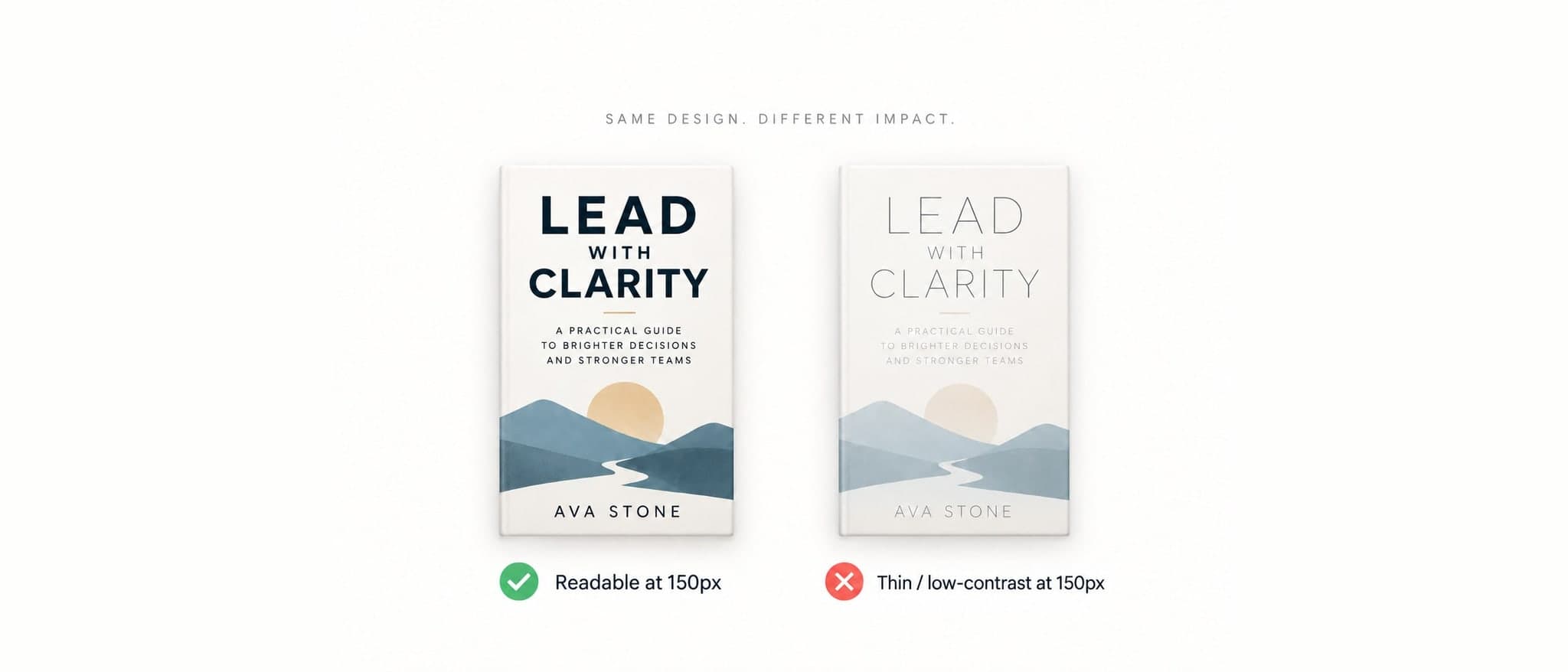
A cover is not decoration. It is a genre signal that a shopper reads in under two seconds while scrolling a grid of thumbnails. If a reader cannot tell whether your book is a cozy mystery, a hard science fiction novel, or a business memoir at thumbnail size, they scroll past it.
Common warning signs:
- Text becomes unreadable when the cover is shrunk to thumbnail size
- The style looks nothing like the top 20 books in your category
- It was designed in a template tool by someone who does not read your genre
- It uses stock imagery that appears on other books

The fix: Pull up the Amazon bestseller list for your exact subcategory. Screenshot the top 20 covers. Look at the shared conventions: the typography weight, the colour palette, the amount of empty space. Your cover should belong on that shelf while still standing out. If yours does not, a professional book cover designis usually the single highest-return investment you can make on a stalled title. For children's titles the same logic applies to interior artwork, which is why consistent children's book illustration matters as much as the cover itself. If you want the full list, we broke down the book cover design mistakes that cost authors sales in a separate guide.
Conversion Problem 02
Your Description Reads Like a Summary Instead of a Sales Page
Most authors write a description that explains what happens in the book. That is a synopsis, and synopses do not sell books. A description needs to create curiosity and promise the reader a specific emotional payoff.
A structure that works well for fiction:
- One. A single-line hook in bold that states the central tension.
- Two. Two or three short paragraphs of rising stakes, written in present tense.
- Three. A cliffhanger question, or a line that implies consequence.
- Four. A short call to action.
For non-fiction, replace the plot beats with the reader's problem, the transformation you promise, and the credibility that makes you the right person to deliver it.
Formatting matters too. Plain unbroken text loses readers. Use bold on your hook, short paragraphs, and white space.
Conversion Problem 03
Your Look Inside Preview Undermines You
A reader who likes your cover clicks Look Inside. If the first pages show inconsistent spacing, orphaned headings, a missing table of contents, awkward chapter breaks, or a font that looks like a word processor default, trust collapses instantly. The reader is not thinking “bad formatting.” They are thinking “amateur,” and they close the tab.
The fix: Have your interior professionally typeset for both print and reflowable ebook. Proper interior formatting covers running heads, chapter openers, correct front and back matter, a functional linked table of contents in the ebook, and a print layout that does not fight the trim size.
Conversion Problem 04
Reviews Are Missing, Thin, or Mentioning Errors
Reviews are social proof and also a conversion floor. A book with three reviews will convert far worse than the same book with thirty, all else being equal. Worse, if the reviews you do have mention typos, plot holes, or confusing structure, every visitor reads that before deciding.
The fix, in order:
- If reviews mention errors, fix the manuscript first. Publishing an unedited book and paying to advertise it is spending money to accelerate bad word of mouth. A round of professional editing and proofreading closes that leak permanently, and KDP lets you upload a corrected file.
- Build an ARC team — ten to twenty readers in your genre who receive an advance copy and post an honest review during launch week.
- Ask inside the book. A short, polite review request on the final page of your ebook works better than most authors expect.
- Never buy reviews. Amazon removes them, and the account risk is not worth it.
Conversion Problem 05
Your Price and Page Count Are Fighting Each Other
Price is a positioning signal. A 90-page non-fiction ebook at $9.99 feels overpriced. A 400-page thriller at $0.99 permanently signals low value if you leave it there. Print pricing is even easier to get wrong, because printing cost scales with page count, and many authors set a price that leaves them almost no royalty — or one so high it never sells.
The fix: Check the top sellers in your subcategory and price inside the band, not outside it. For ebooks, understand where the 70 percent royalty band sits and what happens above and below it. For paperbacks, calculate your print cost first, then work backwards to a retail price that is both competitive and profitable.
Visibility Problem 06
Your Keywords and Categories Are Wrong
This is the most common and most fixable issue on the entire list. Amazon is a search engine before it is a store. Your seven keyword slots and your category placements decide which searches you appear in, and most authors fill them with vague words like “novel,” “fiction,” or “great read.” Those terms carry enormous competition and tell Amazon nothing useful.

What good Amazon KDP keywords look like:
- Phrases, not single words. “Small town enemies to lovers romance” beats “romance.”
- Terms readers actually type, not terms you wish they typed
- Reader intent, mood, and trope language for fiction. Problem and outcome language for non-fiction.
- No repeats of words already in your title, subtitle, or author name, because those are already indexed
- No competitor author names or trademarked terms
Amazon's own KDP help page on keywords confirms the seven-slot limit and warns specifically against vague terms, so it is worth reading straight from the source before you rebuild your list.
How to find them: Type a seed phrase into the Amazon search bar and read the autocomplete suggestions. Those are real searches. Do it for ten seed phrases and build a list. Then check each phrase by searching it and seeing whether the results actually look like your book. If they do not, the phrase is wrong for you.
Categories: Aim for relevant subcategories deep enough that a modest number of sales can move you up the ranking, but not so obscure that no reader ever browses them. You can contact KDP support to request additional category placements beyond what the upload form offers. Then wait — reindexing is not instant, so give any metadata change a couple of weeks before you judge it.
Visibility Problem 07
You Have No Traffic Source Outside Amazon
Amazon rewards books that already sell. That creates a chicken-and-egg problem for new titles, and the way out is to bring your own traffic. If your entire marketing plan was one launch-day post, your book has no engine.
The three engines that work:
- Amazon Ads. The most direct lever, because you are buying attention from people already in shopping mode. Start with a manual keyword campaign built from the research above, set a low daily budget, run it for at least two to four weeks before judging it, and cut keywords with heavy spend and no clicks.
- An email list. The only audience you actually own. A simple author website with a signup offer — a free short story, a first chapter, a companion worksheet — turns one-time readers into people you can reach on your next release.
- A consistent social presence. Not everywhere. One platform where your readers actually gather, posted on consistently. Social media marketing for authorsworks when it builds a relationship over months, not when it shouts “buy my book” at strangers.
Visibility Problem 08
You Published in One Format on One Store
Every format you skip is a group of readers who will never buy from you. Some people only read on Kindle. Some only listen. Some only buy paperbacks as gifts. Some shop on Kobo, Apple Books, Google Play, or through library systems like OverDrive and Hoopla.
The fix: Decide deliberately between Kindle Unlimited exclusivity and going wide, because you cannot do both at once for the ebook. Then make sure you are not leaving the other formats on the table. Audiobook production opens a market with far less competition than ebooks, and global distribution across retail platforms puts your paperback and hardcover in front of readers who never shop on Amazon at all.
Visibility Problem 09
You Treated Launch as a Day Instead of a Season
A single launch-day spike does very little for long-term ranking. What moves a book is sustained sales velocity over weeks, because that is what Amazon's algorithm actually responds to.
A better launch shape:
- Weeks before release: cover reveal, preorder link live, ARC team assembled, email list warmed up
- Launch week: reviews going live, ads switched on at a modest budget, coordinated posts
- Weeks after: promo site features, a price promotion, continued ads, newsletter swaps with authors in your genre
If your book is already out, you have not missed the window. A relaunch is a legitimate strategy, and it usually works better than the original launch because now you have a finished product, real reviews, and data. Our complete guide to publishing a book in 2026 walks through the production side of that reset, from editing through distribution.
How to Market Your Book Changes by Genre
Everything above applies to every book. What changes is where your readers actually are and what convinces them. If you are searching how to market a memoir and following advice written for thriller authors, you will waste money on the wrong channels.

How to Market a Memoir
Memoir readers buy the person, not the plot. They need a reason to care about your specific story before they will spend nine dollars on a stranger's life.
What works: leading with the universal theme rather than the events, since “a story about losing a parent and finding your footing” travels further than a chronological summary. Podcast interviews outperform ads for memoir, because a listener who hears you speak for forty minutes already trusts you. Local press and community groups tied to your subject matter convert well too. If your memoir touches a specific experience — caregiving, immigration, recovery, military service — the communities built around that experience are your first readers.
What does not work: broad Amazon Ads with generic keywords. Memoir is too crowded at the top level to buy your way in cheaply.
How to Sell a Children's Book
This is the genre where authors most often get the marketing model wrong, because the reader and the buyer are two different people. A four-year-old does not browse Amazon. A parent, grandparent, teacher, or librarian does.
What works: the cover and interior art carrying almost the entire sale, since illustration quality is the first and often only judgment a buyer makes. School and library visits, which sell physical copies in volume and build word of mouth. Selling print rather than ebook, because most picture books are bought as physical gifts. And an age range stated clearly in your title, subtitle, and description, since parents search by age constantly.
What does not work: marketing to children. Every message you write should speak to the adult holding the credit card.
How to Market a Novel or Genre Fiction
Fiction readers buy by trope, mood, and comparison. They are looking for the feeling their last favourite book gave them.
What works: naming your tropes explicitly in the description, because readers search for them by name. Comparison titles that set accurate expectations. Series, since the economics of fiction reward book two far more than book one, and a first book priced low becomes a funnel rather than a loss. Amazon Ads work well here, because fiction readers search Amazon directly with very specific phrases.
What does not work: describing your novel as “unlike anything you've read.” Readers want familiar with a twist, not unclassifiable.
How to Sell a Nonfiction or Business Book
Non-fiction readers buy an outcome. They are less interested in you than in what changes for them after reading.
What works: a subtitle that states the promise in plain words, because that is the line that sells the book. Authority signals such as speaking, a newsletter, a podcast appearance, or a professional platform. Treating the book as a lead generator into your consulting, coaching, or services rather than treating royalties as the goal. And keywords built around the problem your reader is trying to solve, not the framework you invented to solve it.
What does not work: clever titles with no explanatory subtitle. Nobody searches for a metaphor.
How to Promote a Poetry Book
Poetry has the smallest search demand and the most loyal readers, so the channels are different again.
What works: individual poems shared publicly as the marketing, because the sample is the sales pitch. Literary magazines, readings, and local events. Beautiful physical objects, since poetry buyers are unusually willing to pay for a well-made print edition. Community first, sales second.
What does not work: paid ads. Search volume is too thin to make them efficient.
The Common Thread
Whatever your genre, the sequence is the same. Make the listing convert, then send traffic to it. The only thing that changes is which traffic source is worth your time and money. If you are unsure which applies to your book, that is exactly the sort of thing a listing review will tell you in an hour.
Your 30-Day Book Recovery Plan

| Days | Focus | Actions |
|---|---|---|
| 1–3 | Diagnose | Check impressions against sales. Decide whether you have a visibility or a conversion problem. Read your own reviews honestly. |
| 4–7 | Metadata | Rebuild your seven keywords from Amazon autocomplete research. Review and request better categories. |
| 8–14 | Conversion | Rewrite the description with a hook-first structure. Audit your cover against the top 20 in your category. Fix any formatting issues visible in Look Inside. |
| 15–21 | Proof | Recruit an ARC or reader team. Add a review request to the back matter. Correct any errors readers have flagged and re-upload the file. |
| 22–30 | Traffic | Launch one small manual Amazon Ads campaign. Set up an email capture page. Choose one social platform and post consistently. |
Do not change everything at once and then wonder what worked. Change one variable at a time and give each change at least two weeks before you judge it.
When It Makes Sense to Bring in Help
Some of this you can absolutely do yourself. Keyword research, category selection, and description rewriting are all learnable skills, and plenty of authors handle them well.
Where authors usually lose money is doing the creative work themselves to save a few hundred dollars, then spending far more on ads pointing at a listing that was never going to convert. Design, editing, and formatting are craft skills. They are also the exact three things a reader judges before they read a single word you wrote.
At Evercrest Publishing, we work with authors on the full path from manuscript to market: editing and proofreading, cover design, interior formatting and print, distribution across global retail platforms, audiobook production, and ongoing book marketing and Amazon Ads.
The Short Version
Flat sales are a signal, not a verdict. Work through the list in order: diagnose whether it is visibility or conversion, fix the metadata because it is free, fix the listing because it decides everything, then and only then spend money on traffic.
Your book is not failing because nobody wants it. It is most likely failing because the right readers have not found it yet, or because the page they landed on did not do it justice.
Ready to find the weak link in your listing? Get in touch with the Evercrest teamfor a review of your book's Amazon presence.
Frequently Asked Questions
How long does it take for a book to start selling on Amazon?
There is no fixed timeline. Books rarely sell steadily on their own without a traffic source. Most titles that build momentum do it through a combination of correct metadata, a converting listing, and consistent promotion over several months rather than through a single launch push.
Will changing my keywords and categories hurt my ranking?
Updating metadata is a normal part of managing a title. Amazon needs time to reindex your book after changes, so allow a couple of weeks before evaluating the effect rather than reverting after a few days.
Should I run Amazon Ads if my book is not selling?
Only after your listing converts. Ads increase traffic to your product page. If the cover, description, and sample pages are not persuading visitors, more traffic simply means more people leaving. Fix conversion first, then advertise.
Is a new cover really worth the cost for a book that is already published?
For a book that receives traffic but few sales, the cover is one of the most likely causes and one of the easiest things to test. You can update your cover file on KDP at any time without republishing the book as a new title.
Do I need reviews before I run any promotion?
It helps significantly. A listing with very few reviews converts poorly regardless of how good the book is. Building a small reader team and gathering honest reviews before spending on promotion usually produces better results than the reverse order.
Can I fix my book's sales without republishing it?
Yes. Keywords, categories, description, price, cover file, and interior file can all be updated on your existing listing. Your reviews and ranking history stay with the book.
My book is not selling and I am a first-time author with no audience. Where do I start?
Start with the parts that cost nothing. Rebuild your keywords, check your categories, and rewrite your description. Those three changes are free and they affect every visitor from that point forward. Only once the listing is solid should you think about how to promote your book with paid traffic.
My book sold well at launch and then stopped. What happened?
This is normal, and it is a velocity problem rather than a quality problem. Launch sales usually come from people who already knew you. Once that group is exhausted, sales fall to whatever your organic discoverability supports. If that number is near zero, the metadata and traffic sections above are where to look. If you would rather not work through it alone, talk to the Evercrest team.